
Plastic packaging · Lviv · KVED 22.22
One cycle, from granule to the stack
PLASTAR is a Lviv company registered in 1999 to make plastic packaging. This page follows one container through an injection-moulding press in the order it happens, and says what the buyer decides at each step.
The pictures on this site are illustrations made for it. They are not photographs of our premises or of a particular product.
1/6Granule
Every container starts as a few grams of granules
Packaging grades of polypropylene and high-density polyethylene arrive as pellets a few millimetres across, in big bags. Nothing about the finished bucket is in them yet except the material itself. Natural polypropylene is milky and slightly translucent; white, and every other colour, is a concentrated colour pellet — a masterbatch — dosed in at the machine.
So the first decisions are made before anything is heated: which material family, which colour, and whether the container will hold food. Food contact narrows the choice to grades and colourants declared for that use, and it is far easier to say so at the start than to discover it after a mould has been cut.

Natural polypropylene is milky. Every other colour is added at the machine.
What each material is good for, and the code it carries on the base: Materials.
2/6Melt
A turning screw makes one even melt
The weight of the part is decided here, before anything is moulded.
Inside the barrel of the moulding machine a screw turns within heated zones. It carries the pellets forward, shears them and melts them into one uniform mass that gathers in front of the screw. Polypropylene is usually processed somewhere around 200 to 250 °C, and the aim is not heat for its own sake but a melt with the same temperature and colour all the way through.
The amount gathered — the shot — is the weight of the container. A lighter wall uses less material across a long run, but a wall taken too thin buckles under a stack or cracks at a cold handle lug. Where a container sits between those two is a design decision, and it is worth making with the filled weight and the storage conditions in front of you.
3/6Fill
The mould fills in a second or two
The screw stops turning and drives forward like a plunger. The melt is injected through a small gate into the space between two steel halves: the cavity, which forms the outside of the container, and the core, which forms the inside. A thin tub fills in a fraction of a second, a heavier bucket in a second or two.
What the buyer decides at this step is mostly the shape, because the shape is the mould. Volume, the proportion of height to width, the rim a lid snaps over, the lugs for a handle, a tamper-evident band — all of it is cut into steel for one design. A new shape means a new mould, and a new mould is the longest lead time in plastic packaging. Using a shape that already exists is often the quickest route to a first delivery.
- volume to the brim
- rim and lid fit
- handle lugs
- tamper-evident band
- taper, for nesting
4/6Hold and cool
Most of the cycle is spent waiting for it to cool
Once the cavity is full, pressure is held for a moment so the part does not shrink away from the steel. Then nothing visible happens: cold water runs through channels in the mould and the container sets until it is stiff enough to come out without distorting. In most packaging cycles this is the longest stretch.
- Cooling takes the largest share
- Fill is over almost at once
- proportions only — every mould is timed on the machine
This is why wall thickness matters so much. Cooling time grows quickly with the thickest point of a part, so a single heavy rib or an over-built base slows every container in the run. An even wall cools evenly and comes out flat; a wall that is thick in one place and thin in another tends to warp, and a warped rim is a lid that will not close.
5/6Open
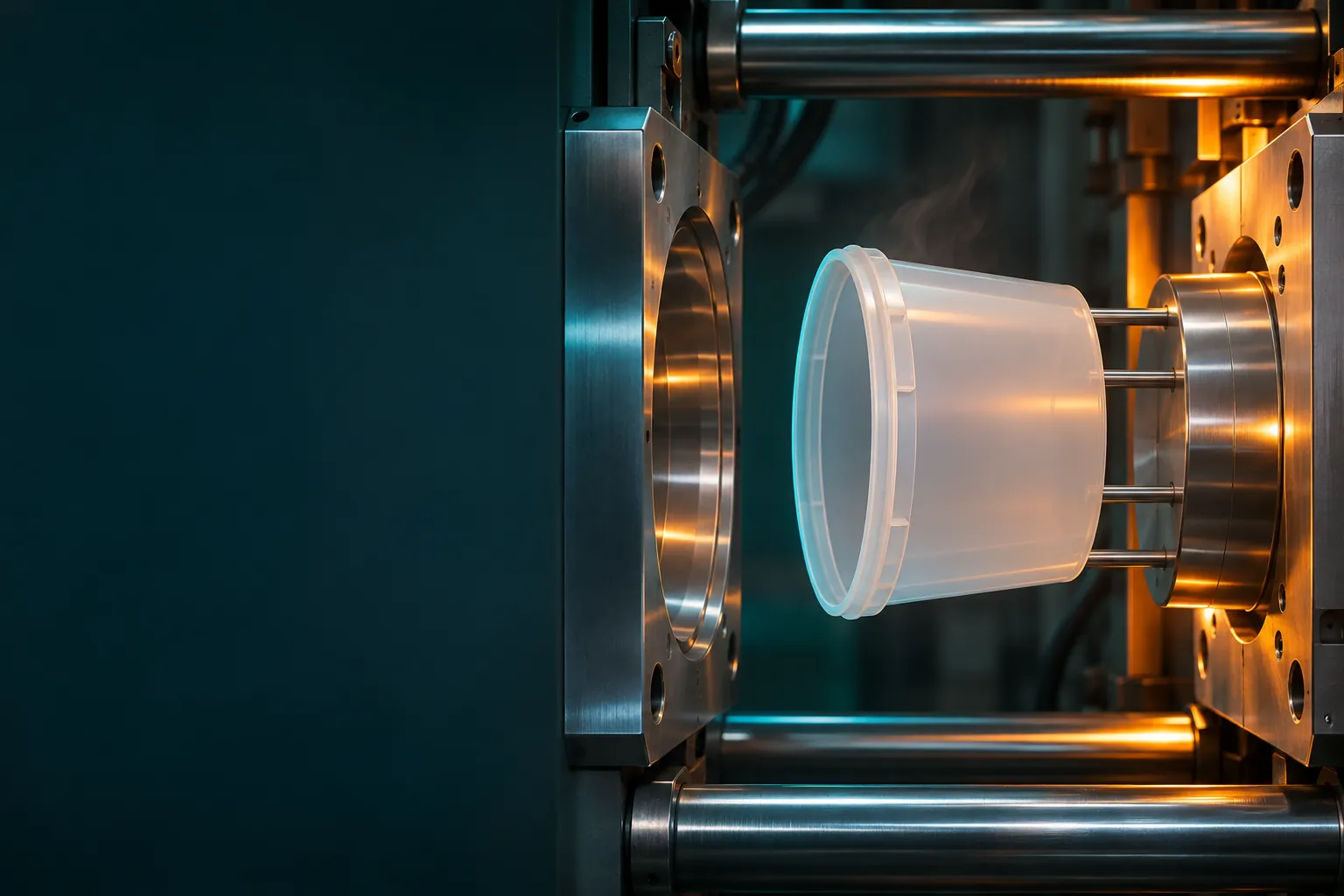
The mould opens and the part is pushed free
The moving half draws back. Ejector pins or a stripper ring push the container off the core, and it falls clear or is lifted out, and the mould closes again for the next shot. A run is the same few seconds repeated thousands of times, so the first parts off a new run are the ones looked at hardest.
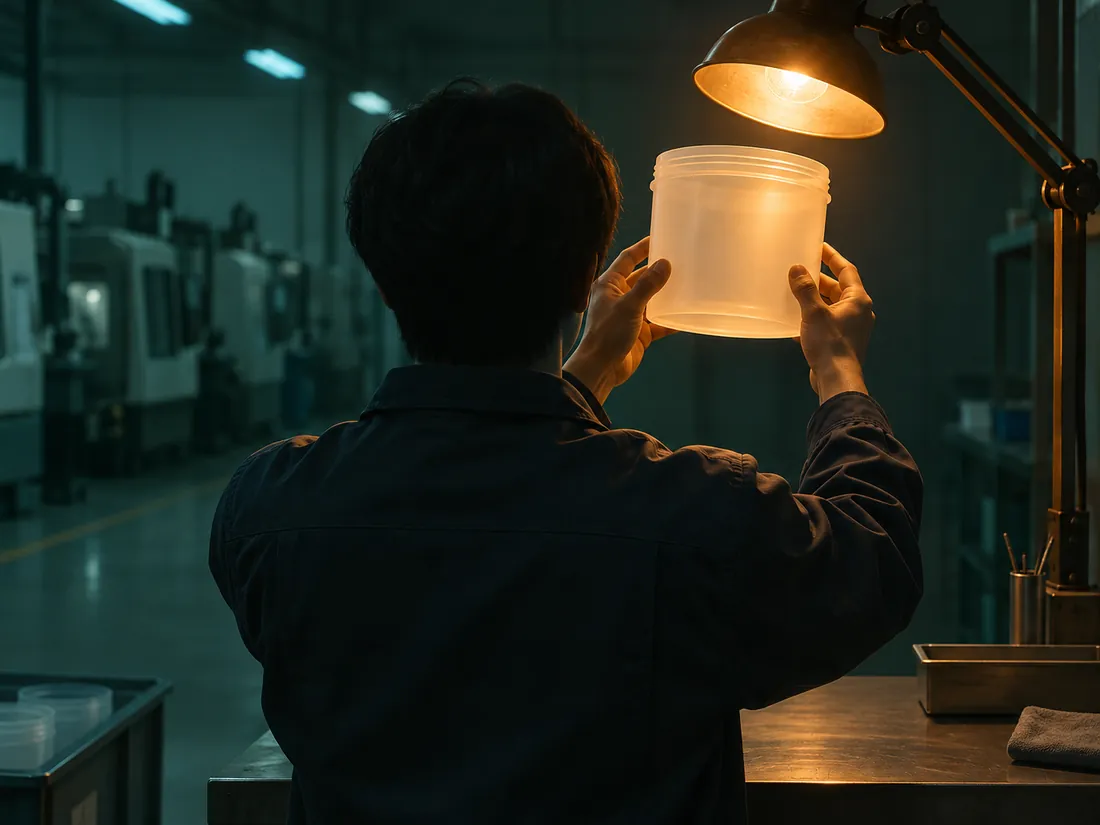
Held to the light, an even wall glows evenly; a thin patch shows as a brighter streak. Then the rim is measured, a lid is pressed on and pulled off, and the part is weighed, because the weight says whether the shot is right.

6/6Stack
Then it goes on the stack
Empty, a tapered container drops into the one below it, so a pallet of empty buckets is mostly air that was never shipped. Filled and lidded, they stand on their rims, and the rim and the lid carry the load.
How far each empty container sits above the last — the nest step — is set by the taper and the stacking lugs in the mould. It decides how many fit in a carton or under a pallet height, which is a sum anyone can do.
Before a brief
What we need to hear from you
Most enquiries about packaging start with a picture of something similar. That helps, but six facts help more, and they line up with the steps above: what the container will hold, how much, in which material, how it closes, in what colour, and how many are needed per run. Where it will be filled and stored matters too — a bucket for paste in a warm room and one for frozen fruit are not the same part.
We read every brief and answer by email from the company's own address. Nothing is ordered by sending one.
- what goes inside
- volume
- material, if known
- closure
- colour
- pieces per run
- where it is filled
PLASTAR TOV, Lviv
- Legal name
- ТОВ «ПЛАСТАР» · PLASTAR TOV
- EDRPOU code
- 30539188
- D-U-N-S
- 681179162
- Registered
- 3 September 1999, Lviv
- Main activity
- KVED 22.22 — manufacture of plastic packing goods
- Also
- KVED 22.29 other plastic products · 46.49 wholesale of household goods
Full registered details: Company.